Address
304 North Cardinal
St. Dorchester Center, MA 02124
Work Hours
Monday to Friday: 7AM - 7PM
Weekend: 10AM - 5PM
Address
304 North Cardinal
St. Dorchester Center, MA 02124
Work Hours
Monday to Friday: 7AM - 7PM
Weekend: 10AM - 5PM


Sourcing bulk vinyl windows from overseas manufacturers is often viewed as the ultimate cost-saving strategy for large-scale real estate developers. However, without strict quality control, importing these units can quickly become a financial nightmare. In my 15 years overseeing wholesale stock vinyl windows procurement, I have seen countless developers lose up to 30% of their profit margins due to hidden manufacturing defects, brutal freight damage, and catastrophic sizing errors on the construction site.
If you are planning to import bulk vinyl windows for your next multi-family or commercial project, you must understand the exact technical specifications that separate high-performance units from cheap liabilities. Mastering this sizing chart and compliance checklist is critical. It is not just about finding the lowest price; it is about securing bulk vinyl windows that actually pass local building inspections and survive heavy commercial usage. By mastering the strategies in this guide, you will bypass the errors that destroy 30% of standard purchasing budgets.
The global demand for energy-efficient commercial buildings has fundamentally shifted how contractors approach procurement. According to recent data from Grand View Research, the U.S. commercial windows market is projected to reach USD 3.45 billion in 2026, driven by a compound annual growth rate (CAGR) of 5.7%. The driving force? Extremely strict energy codes and the rapid adoption of green building standards.
For overseas buyers, this means you can no longer simply import vinyl windows based on aesthetic appeal alone. Modern commercial projects demand precise U-factors, strict Solar Heat Gain Coefficient (SHGC) ratings, and flawless acoustic insulation. Let us dive into the critical evaluation criteria you must enforce when vetting your next builder supply multi-family vinyl windows shipment.
Nothing destroys a contractor’s reputation faster than a massive commercial project experiencing window seal failures within the first two years. When a building manager calls to complain about condensation and fogging between the glass panes, you are looking at catastrophic warranty replacement costs. Why do commercial vinyl windows fail seal tests so frequently?
The root cause of most Insulated Glass Unit (IGU) failures in wholesale B2B vinyl window distribution is the use of cheap aluminum spacers. Aluminum is highly conductive. When exposed to extreme temperature fluctuations, it expands and contracts violently, eventually shredding the primary butyl seal. Once that seal breaks, moisture enters the cavity, resulting in the dreaded fog.
To eliminate this, you must demand Warm Edge Spacers (such as flexible silicone or stainless-steel composite spacers). These advanced components absorb the stress of thermal expansion, ensuring the edge seal remains intact even in brutal climates. When sourcing commercial grade heavy duty vinyl windows, always specify non-metallic or thermally broken spacers in your purchasing contract.
Many contractors ask: do argon windows eventually lose gas? Yes, a minor diffusion rate of less than 1% per year is normal. However, a complete seal failure accelerates this loss, and according to GlassOnWeb industry research, losing your insulating gas can worsen your U-factor by up to 32%. This is a game-changing loss of energy efficiency.
To maintain high argon gas retention, the construction of the vinyl frame is equally critical. Mechanically fastened corners will eventually leak air. You must source fusion welded vinyl window frames. The fusion welding process melts the corners together, creating a permanent, watertight, and airtight monolith that protects the IGU and ensures your low-E argon gas bulk windows maintain their thermal performance for decades.
Residential windows are opened perhaps twice a week gently by a homeowner. Commercial windows in rental apartments, hotels, or office buildings face daily, aggressive handling by tenants who do not care about your maintenance budget. Sourcing standard residential hardware for a commercial project is a guaranteed path to snapping hinges and broken handles.
When evaluating builder supply vinyl windows, pay close attention to the locking mechanisms. A single-point lock concentrates all the closing force and structural stress onto one tiny piece of zinc or cheap steel. Under heavy commercial use, it will snap.
You must specify heavy duty window hardware commercial applications. Multi-point locking systems distribute the locking force across three or more points along the window sash. Not only does this prevent hardware fatigue, but it also tightly compresses the weatherstripping against the frame, vastly improving the window’s air infiltration rating and acoustic performance.
Modern commercial architecture favors massive expanses of glass. What causes hardware failure in large vinyl windows? Weight. Double glazed or triple glazed units are incredibly heavy. If your factory uses standard hinges for a custom size container load vinyl windows order, the sashes will sag within months, making them impossible to close. Always demand stainless steel, heavy-duty friction hinges rated for at least 150 lbs of sash weight for any commercial project.
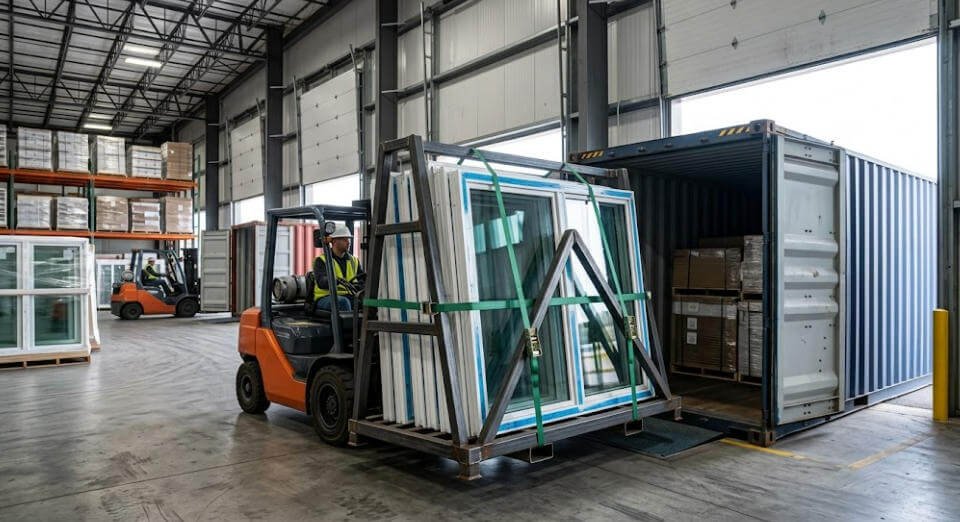
Imagine waiting six weeks for your container load vinyl windows to cross the ocean, only to open the doors and find 15% of your inventory shattered. How to prevent glass breakage during sea freight is one of the most critical, yet overlooked, aspects of importing.
Most overseas factories will quote you using standard wooden crating. While cheap, wooden crates lack the structural rigidity to survive the violent pitching and rolling of a cargo ship. Furthermore, stacked wooden crates compress under their own weight, crushing the frames at the bottom.
For zero-breakage container strategies, you must insist on Steel A-Frames. A steel A-frame securely holds the windows upright at a precise angle, distributing the weight evenly and absorbing shock. The windows are strapped directly to the rigid metal structure, eliminating the friction and compression that destroy wooden crates. While it may add a slight upfront cost, utilizing steel A-frames is a cost-saving necessity that virtually eliminates hidden costs of cheap wholesale vinyl windows.
Never trust a factory’s theoretical maximum volume. Always calculate based on the footprint of the steel A-frames, not the raw cubic meters of the windows. Leave a 10% tolerance for secure lashing and forklift access to prevent fork damage during unloading.
Resolving window size discrepancies on construction sites is a nightmare that halts entire projects. When framing contractors build rough openings to exact US Imperial measurements, and your factory produces windows using rounded Metric conversions, the result is an installation disaster.
The metric to imperial conversion chaos happens because 1 inch equals exactly 25.4 millimeters. If an overseas factory rounds 36 inches down to 900mm instead of the precise 914.4mm, the window will be too loose, requiring excessive shimming and compromising the waterproofing. You must provide your supplier with CAD drawings that explicitly state the final manufacturing size in millimeters to the decimal point, and force them to guarantee a manufacturing tolerance of +/- 2mm.
Another massive trap involves nail fin tolerances. What are the rough opening tolerances for commercial building windows? Typically, the rough opening should be 1/2 inch larger than the net window size. However, if your factory uses a flimsy, badly extruded nail fin, it will crack when the contractor shoots a nail through it.
You must specify integral (extruded) nail fins for new construction, or precise flush fins for retrofit applications. At Havenseek Window, our commercial window solutions employ heavy-wall integrated nail fins that guarantee structural integrity during rapid commercial installation, eliminating onsite delays.
You can import the most beautiful, high SHGC rating imported windows in the world, but if they lack the proper paperwork, the local municipal building inspector will reject them instantly. How to win construction bids with stock windows comes down to one thing: irrefutable compliance.
In North America, the National Fenestration Rating Council (NFRC) is the absolute authority. For 2025 and 2026, ENERGY STAR has mandated even stricter criteria for their “Most Efficient” label. If you are submitting an energy star certified bulk window supplier bid, the U-Factor must generally sit at 0.20 or lower for Northern climates, while Southern climates demand aggressive SHGC blocking.
Many buyers fall for the trap of buying NFRC certified vs non-certified imported windows based solely on factory promises. You must request the physical NFRC CPD (Certified Products Directory) number from the factory and verify it online before transferring any deposit. If your CE certified commercial window factory is targeting Europe, ensure their Declaration of Performance (DoP) is current and covers the exact glass package you are ordering.
In late 2025, a multi-family developer in Texas faced bid rejection due to high SHGC numbers. By switching to Havenseek’s custom low-E argon gas bulk windows with warm edge spacers, they achieved a verified SHGC of 0.21. Not only did they pass inspection, but the property management firm reported a 35% decrease in summer cooling costs.
Importing commercial windows does not have to be a gamble. By demanding structural multi-point hardware, enforcing steel A-frame packing, meticulously checking rough opening conversion math, and insisting on verifiable NFRC or CE data, you can successfully leverage overseas manufacturing to drastically improve your project margins.
Are you ready to stop gambling on your project budgets and start sourcing reliable, certified bulk vinyl windows? Partner with a factory that understands international building codes and commercial durability standards.
Download our 2026 Commercial Window Catalog PDF or speak directly with our engineering team for a project evaluation.
Request Free Sample & Get a Free Quote in 12 Hours